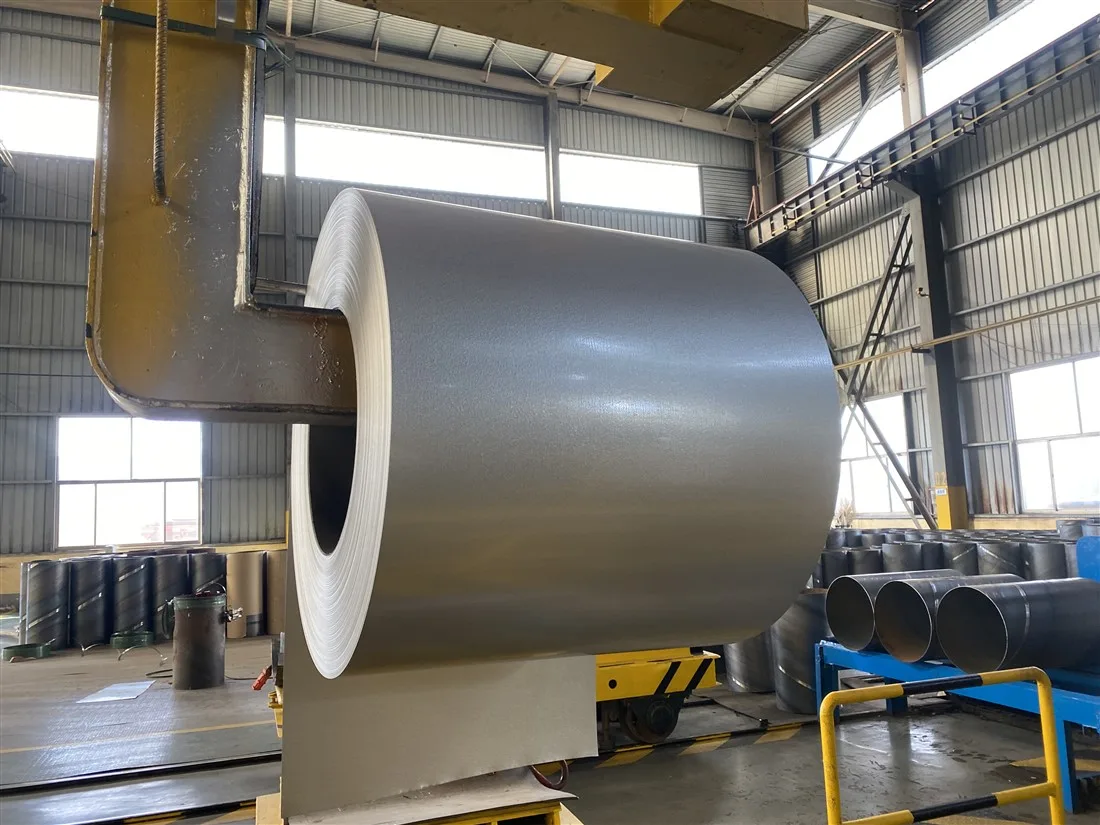
Galvalume Steel Coil (GL) Explained: 55% Al-Zn Performance Data and How to Specify AZ50-AZ185
A practical GL coil specification guide: the 55% Al-Zn alloy principle, GL vs GI performance data, AZ50-AZ185 coating mass explained, applications, and surface treatment selection.
When a roofing or cladding project needs corrosion resistance beyond what pure zinc can deliver, buyers turn to Galvalume steel coil — commonly abbreviated as GL or Aluzinc. Galvalume is steel coated with an aluminum–zinc alloy that combines the barrier protection of aluminum with the sacrificial protection of zinc. The result is a coated steel that typically lasts two to four times longer than equivalent galvanized (GI) coil in the same outdoor environment.
This guide explains what the 55% aluminum–zinc coating really means, how to read AZ coating designations, how GL compares to GI with real performance data, and how to specify the right GL coil for your climate and application.
What Makes Galvalume Different: The 55% Al–Zn Alloy
Galvalume is produced on continuous galvanizing lines where cold-rolled steel strip is immersed in a molten bath containing approximately 55% aluminum, 43.4% zinc, and 1.6% silicon. The silicon controls alloy growth and improves coating adhesion and formability.
The high aluminum content gives Galvalume two decisive advantages over pure zinc coatings:
- Superior flat-surface corrosion resistance — aluminum forms a stable oxide barrier that slows corrosion on the flat panel.
- Heat reflectivity — the bright metallic surface reflects solar radiation, reducing roof temperatures and cooling loads.
- Heat resistance — Galvalume performs continuously up to about 315°C, roughly 85°C higher than typical galvanized limits.
Note that because aluminum does not migrate to cut edges, Galvalume provides less sacrificial edge protection than pure zinc. For this reason, cut edges on GL panels should be protected or painted where severe exposure is expected.
GL vs GI: Head-to-Head Performance Data
| Property | Galvalume (GL) | Galvanized (GI) |
|---|---|---|
| Coating composition | 55% Al / 43.4% Zn / 1.6% Si | Pure zinc (with trace elements) |
| Flat-panel corrosion life | 2–4× longer in most atmospheres | Baseline |
| Cut-edge protection | Lower (Al does not migrate) | Excellent (Zn migrates to edges) |
| Heat resistance | Up to ~315°C | Up to ~230°C |
| Solar reflectivity | High | Moderate |
| Typical cost premium | 5–15% higher than GI | Baseline |
| Best applications | Roofing, solar structures, heat zones, PPGL substrate | Construction, ducts, tubes, fabrication |
The classic rule quoted across the industry: AZ50 (AZM150) Galvalume provides at least twice the corrosion life of G90 (Z275) galvanized in many atmospheres. In highly corrosive industrial or salt-laden environments the gap narrows, but GL still retains a meaningful advantage on flat surfaces.
Decoding AZ Coating Masses: AZ50, AZ100, AZ150, AZ185
Galvalume coating weight is designated by the AZ prefix followed by the coating mass in grams per square meter (g/m²) across both sides.
| Designation | Total Coating (both sides) | Equivalent (imperial) | Typical Use |
|---|---|---|---|
| AZ50 | ~150 g/m² (AZM150) | AZ50 | Economy roofing, interior |
| AZ100 | 100 g/m² | — | Standard roofing in moderate climates |
| AZ150 | 150 g/m² | AZ50 (closest) | Standard roofing and cladding worldwide |
| AZ185 | 185 g/m² | AZ55 | Coastal, marine, industrial, solar structures |
For most roofing projects globally, AZ150 is the de facto standard — roughly 150 g/m² total, about 75 g/m² per side. Where the atmosphere is aggressive, step up to AZ180–AZ210 rather than relying on thinner coatings.
Understanding the g/m² to Micron Conversion
Buyers sometimes need coating thickness rather than weight. For Galvalume, a useful approximation is 1 µm of coating thickness ≈ 3.75 g/m² of coating weight. So an AZ150 coating is roughly 40 µm total thickness across both surfaces, or about 20 µm per side. (For comparison, the imperial unit 1 oz/ft² ≈ 305 g/m².)
Where Galvalume Excels: Applications
- Metal roofing and wall cladding — the largest single application, favored for heat reflectivity and long life.
- Solar mounting structures — GL's durability and corrosion performance suit 25-year PV warranties.
- Pre-engineered buildings (PEB) — as bare GL and as PPGL substrate.
- Agricultural and industrial buildings — where humidity, ammonia, and temperature cycling accelerate corrosion.
- HVAC components — heat resistance and formability make GL a strong fit.
Surface Treatments and Storage Considerations
GL coils are available with chromate passivation, chromium-free passivation, anti-fingerprint (AFP), oiled, or dry surfaces. AFP film is popular for visible architectural panels because it prevents fingerprint marking during handling. As with GI, avoid condensation, freshwater contact, and prolonged open storage; white rust on the aluminum–zinc surface indicates wet storage and is grounds for a quality claim.
Frequently Asked Questions
Conclusion
Galvalume is not a substitute for galvanized steel — it is a different tool for a different job. Where flat-surface corrosion resistance, heat reflectivity, and long roof life matter, GL typically beats GI on total cost of ownership despite a modest material premium. Specify AZ150 as the baseline, move to AZ180–AZ210 for aggressive atmospheres, and protect cut edges where exposure is severe.
SUNSEA STEEL CO., LIMITED supplies Galvalume coils from AZ50 to AZ185 in thicknesses of 0.12–2.0 mm and widths of 600–1500 mm, certified to ASTM A792, EN 10346, and JIS G3321. Talk through your project with our engineers: email [email protected] or message +86 152 6555 2259 on WhatsApp for a specification review and quotation.
Frequently Asked Questions
What is the difference between Galvalume (GL) and galvanized (GI) steel coil?
GI is coated with pure zinc, while GL is coated with a 55% aluminum / 43.4% zinc / 1.6% silicon alloy. Galvalume provides 2-4x longer flat-surface corrosion life, higher heat reflectivity, and better heat resistance, but galvanized offers superior cut-edge protection because zinc migrates sacrificially to edges.
What does AZ150 mean in Galvalume coating?
AZ150 means a total Al-Zn coating weight of approximately 150 g/m² across both sides (about 75 g/m² per side, roughly 40 µm total). It is the most widely specified Galvalume coating for standard roofing and cladding worldwide.
How much longer does Galvalume last compared to galvanized steel?
In most outdoor atmospheres, AZ50 (AZM150) Galvalume is commonly cited as providing at least 2x the corrosion life of G90 (Z275) galvanized. The advantage is greatest in clean and industrial atmospheres and somewhat narrower in aggressive marine exposure.
Can Galvalume steel be used as a substrate for painted coils?
Yes. GL coil is the preferred substrate for PPGL (prepainted Galvalume) coils. The Al-Zn coating provides a corrosion-resistant base that extends the service life of the paint system, making PPGL the highest-durability prepainted product available.
What is AFP (anti-fingerprint) treatment on Galvalume coil?
AFP is a clear, chromium-free protective film applied to the Galvalume surface. It prevents fingerprint marks and minor scratches during handling and installation, and is commonly specified for visible architectural panels and interior wall cladding.
Is Galvalume coil suitable for coastal and marine environments?
Galvalume performs well in coastal environments on flat surfaces, but because it offers limited sacrificial edge protection, cut edges must be protected or painted. For severe marine exposure, AZ180-AZ210 coating or a PPGL product is often recommended.
What standards do Galvalume coils conform to?
Galvalume coils are commonly produced to ASTM A792/A792M, EN 10346 (e.g. DX51D+AZ, DX52D+AZ, S350GD+AZ), and JIS G3321. Mills provide mill test certificates (MTC) per EN 10204 Type 3.1 with each shipment.