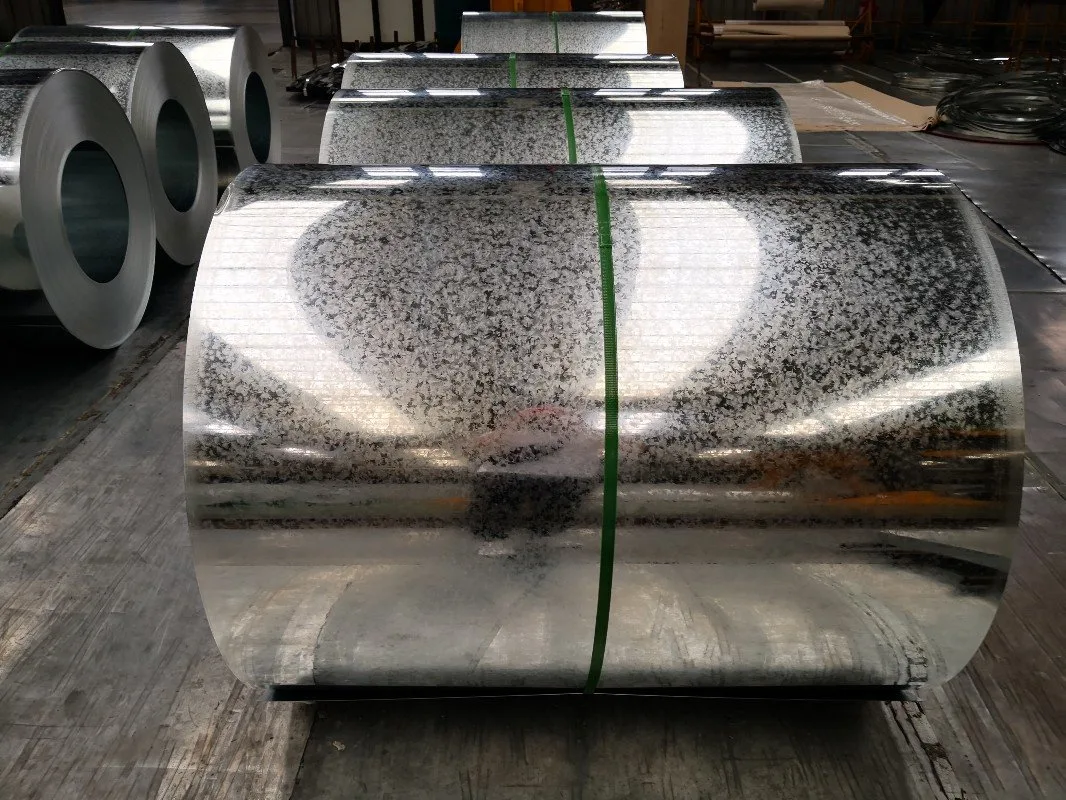
Hot-Dip Galvanized Steel Coil (GI) Buying Guide: Coating Grades, Spangle Selection, and Factory Inspection
A complete GI coil guide for procurement teams and engineers: Z40-Z275 coating grades, spangle and surface selection, receiving inspection checklist, applications, and seaworthy packaging requirements.
Galvanized steel coil — often shortened to GI coil or hot-dip galvanized (HDG) coil — is the most widely specified coated steel product in the construction industry. It forms the substrate for roofing sheets, wall cladding, steel framing, ductwork, and hundreds of fabricated building components.
Yet the majority of buyers treat a galvanized coil as a commodity: they compare price per ton and move on. In practice, coating grade, spangle class, surface treatment, and coating structure determine how long that coil will survive in your climate — and a poorly specified coil can fail years before its theoretical service life. This guide walks procurement teams and engineers through every decision point, from zinc coating mass to the inspection checklist that should accompany every shipment.
How Hot-Dip Galvanizing Works: From Pickled Steel to Zinc-Coated Coil
Hot-dip galvanizing is a continuous process. Cold-rolled steel strip is cleaned and annealed in a reducing atmosphere, then immersed in a bath of molten zinc at roughly 450–460°C. As the strip exits the bath, an iron–zinc alloy layer forms at the interface, followed by a pure zinc layer on top. The result is a metallurgically bonded coating that will not flake or peel during roll forming, stamping, or corrugating.
Two properties make zinc uniquely suited to protecting steel. First, it provides a barrier: the zinc layer physically separates the steel from oxygen and moisture. Second, it is sacrificial: when the coating is scratched or cut, zinc corrodes preferentially and protects the exposed steel at the cut edge. This self-healing, cathodic protection is the reason galvanized steel outperforms painted steel at cut edges and drilled holes.
Decoding Coating Grades: What Z40–Z275 Really Means
Coating weight is expressed in grams per square meter (g/m²) measured across both sides of the strip. The designation Z275, for example, means 275 g/m² total zinc on both surfaces — the industry shorthand for the classic 1 oz/ft² (G90) coating commonly specified in North American markets.
| Designation | Total Coating (both sides) | Typical Applications |
|---|---|---|
| Z40–Z60 | 40–60 g/m² | Indoor light gauge framing, ductwork, electrical enclosures |
| Z100–Z120 | 100–120 g/m² | Standard roofing and cladding in moderate climates |
| Z180–Z220 | 180–220 g/m² | Coastal and industrial atmospheres, agricultural buildings |
| Z275 | 275 g/m² (G90) | Severe marine exposure, long-service-life roofing |
As a rule of thumb, doubling the coating weight roughly doubles the time to 5% red rust in a given atmosphere. Select the lightest coating that meets your design life, then add one grade of margin for handling losses and edge damage during installation.
Spangle, Surface Finish, and Coating Structure
Three spangle classes are available, and the choice is not purely cosmetic:
- Regular spangle — visible crystalline pattern; lowest cost; widely accepted for construction and general fabrication.
- Mini spangle — fine, uniform grain; preferred when a smooth, consistent painted or pre-painted surface is required.
- Zero spangle — inhibited zinc crystal growth for a uniform matte finish; used for appliance housings and high-end cladding where surface consistency matters.
Surface treatment is equally important. Chromate passivation provides temporary wet-storage-stain protection during transit and storage. Chromium-free passivation is available for projects with environmental restrictions. Anti-fingerprint (AFP) film protects visible surfaces during handling, while oiled coils add a thin protective layer that must be degreased before painting or welding.
The Buyer's Inspection Checklist for GI Coils
A mill test certificate (MTC) is not a substitute for your own inspection. Before accepting a shipment, check:
- Coating weight — verify the declared Z-grade with a magnetic thickness gauge or weigh-strip analysis; allow the ±10% tolerance bands of ASTM A653 / EN 10346.
- Surface condition — inspect for rust staining, black spots from wet storage, white rust, scratches, and edge burrs.
- Flatness and shape — confirm coil width, thickness, camber, and that the strip is free of coil breaks and edge waves.
- Coating adhesion — perform a simple bend test on a sample; the coating should not crack or flake on the outside of a 180° bend.
- Packaging integrity — verify the wrap, VCI paper, edge protection, and coil eye protection are intact before accepting damage claims.
Where GI Coils Deliver the Best Value: Applications
Galvanized coil is specified wherever steel needs corrosion resistance at an economic cost:
- Roofing and cladding — as a standalone profile or as the substrate for prepainted (PPGI) products.
- Steel framing — light-gauge wall and roof trusses, purlins, and studs.
- HVAC and ductwork — low-Z grades where internal, conditioned environments apply.
- Home appliances — zero-spangle finishes for visible panels.
- Agricultural buildings — high-Z grades where ammonia and moisture accelerate corrosion.
Packaging, Handling, and Shipping Considerations
GI coils are shipped in seaworthy export packaging: steel coil eye protection, polyfilm and VCI paper wrap, edge protectors, and steel strapping on pallets or in containers. Moisture is the enemy — avoid open storage, condensation cycles, and contact with fresh water during transit. Properly handled coils can be stored outdoors for months without developing white rust.
Frequently Asked Questions
Conclusion
A galvanized coil is only as good as its specification. Match the Z-grade to the atmosphere, choose the spangle and surface treatment for your fabrication route, and verify every shipment against a written checklist. When in doubt, ask your supplier to justify each parameter with data — reputable mills and trading partners publish coating, adhesion, and flatness test results on request.
At SUNSEA STEEL CO., LIMITED, our GI coils are produced on continuous galvanizing lines in widths from 600–1250 mm and thicknesses from 0.11–2.0 mm, with Z40–Z275 coating, regular/mini/zero spangle, and chromated, chromium-free, AFP, oiled, or dry surfaces. Ready to discuss your specification? Email [email protected] or reach us on WhatsApp at +86 152 6555 2259 for a factory-direct quotation.
Frequently Asked Questions
What is the difference between Z40 and Z275 galvanized steel coil?
The number refers to total zinc coating weight on both sides in g/m². Z40 means 40 g/m² total and is suitable for indoor light-gauge applications, while Z275 (equivalent to G90) means 275 g/m² total and provides roughly twice to three times the corrosion life of Z100 in outdoor, coastal, or industrial atmospheres.
How do I choose between regular, mini, and zero spangle GI coil?
Regular spangle is the most economical and suits general construction. Mini spangle provides a finer, uniform surface preferred for prepainted or visible applications. Zero spangle offers the smoothest finish for appliance housings and premium cladding where surface consistency is critical.
What is chromate passivation, and is chromium-free treatment available?
Chromate passivation is a thin conversion layer applied to the zinc surface to prevent white rust during transit and storage. Chromium-free passivation is also available and is preferred for projects with environmental or health restrictions, offering comparable temporary protection.
What common quality defects should I check when receiving GI coils?
Inspect for white rust (wet storage stain), black spots, red rust staining, scratches, edge burrs, coil breaks, and edge waves. Verify the declared coating weight with a magnetic gauge and confirm the mill test certificate matches the delivered specification.
Can galvanized steel coil be painted or powder coated later?
Yes, but the surface must be clean and suitably prepared. Oiled coils must be degreased first; passivated surfaces may need a primer for long-term paint adhesion. For consistent factory-finished color, many projects instead choose prepainted (PPGI) coil directly.
What coating grade is recommended for roofing in coastal areas?
For marine and coastal exposure, Z275 (G90) or equivalent heavy coatings are commonly specified, often combined with proper edge protection. For longer service life in severe marine environments, a Galvalume (GL) or prepainted Galvalume (PPGL) product is often a better long-term value.
What are the typical MOQ and lead time for galvanized steel coils?
A typical minimum order is 25 metric tons per specification. Standard production lead time is 15-20 days depending on width, coating grade, and quantity, followed by 3-7 days for export packing and shipping arrangements.