What Is Galvanized Steel Coil and How Do You Choose the Right GI Coil for Your Project?
What Is Galvanized Steel Coil and How Do You Choose the Right GI Coil for Your Project?
Galvanized steel coil is one of the most widely used coated steel products in the global steel market. It combines the strength and formability of steel with the corrosion protection of zinc, making it suitable for roofing sheets, wall panels, ventilation ducts, home appliances, automotive parts, steel structures and many other industrial applications.
For buyers, importers, contractors and manufacturers, however, galvanized steel coil is not a single simple product. Different base metals, zinc coating weights, surface finishes, mechanical properties and international standards can lead to very different performance and cost outcomes. Choosing the wrong specification may cause premature corrosion, processing problems, coating failure, material waste or unnecessary purchasing cost.
This guide explains galvanized steel coil from a professional purchasing and application perspective. It covers what GI coil is, how it is made, what zinc coating means, which standards are commonly used, how to evaluate quality, and how to select the right product for your project.
1. What Is Galvanized Steel Coil?
Galvanized steel coil, often called GI coil, is a steel coil coated with a protective layer of zinc. The zinc layer acts as a barrier between the steel substrate and the surrounding environment. It also provides sacrificial protection, which means zinc corrodes preferentially before the steel underneath is attacked.
The base material is usually cold rolled steel or hot rolled pickled steel. After surface cleaning, heat treatment and zinc coating, the steel strip is wound into coils for further processing or direct use. Galvanized steel coil can be slit, cut to length, roll formed, stamped, bent, profiled, painted or used as a substrate for pre-painted galvanized steel coil.
The value of galvanized steel coil comes from the combination of three essential properties:
- Strength: the steel substrate provides mechanical support and structural performance.
- Corrosion resistance: the zinc coating protects the steel from rust and oxidation.
- Processability: the coil form allows efficient production, transportation and downstream fabrication.
Because of these advantages, galvanized steel coil is widely used in construction, industrial manufacturing, agricultural equipment, HVAC systems, household appliances, automotive components and international steel distribution.
2. How Is Galvanized Steel Coil Produced?
The most common production method is the continuous hot dip galvanizing process. In this process, steel strip passes through a series of controlled production stages before being coated with molten zinc.
Key production steps
- Uncoiling: the steel coil is opened and continuously fed into the galvanizing line.
- Cleaning and degreasing: oil, dust and surface contaminants are removed to ensure good coating adhesion.
- Annealing: the steel strip is heated in a controlled atmosphere to improve mechanical properties and formability.
- Hot dip galvanizing: the strip enters a molten zinc bath where zinc bonds to the steel surface.
- Air knife control: high-pressure air knives regulate zinc coating thickness on both sides of the strip.
- Cooling: the coated strip is cooled to stabilize the coating and surface condition.
- Skin pass and tension leveling: these processes improve flatness, surface appearance and dimensional stability.
- Surface treatment: passivation, oiling, chromate-free treatment or anti-fingerprint coating may be applied.
- Recoiling and packaging: the finished galvanized steel strip is wound into coils and packed for storage or shipment.
Among these steps, zinc coating control, strip flatness, surface cleanliness and base metal consistency are especially important. A professional galvanized steel coil supplier should be able to control these factors and provide stable quality for repeated orders.
3. Hot Dipped Galvanized Coil vs Electro Galvanized Coil: What Is the Difference?
Although both products are zinc-coated steel materials, hot dipped galvanized steel coil and electro galvanized steel coil are made by different processes and serve different market needs.
Hot dipped galvanized steel coil
Hot dipped galvanized steel coil is produced by immersing steel strip into molten zinc. This method usually creates a thicker zinc coating, making it suitable for outdoor use and applications requiring stronger corrosion resistance.
Main advantages include:
- Higher zinc coating weight options
- Good corrosion resistance for construction and industrial use
- Efficient mass production
- Competitive cost-performance balance
- Wide availability in international markets
Electro galvanized steel coil
Electro galvanized steel coil is coated through an electrochemical deposition process. Its surface is often smoother and more uniform, but the zinc coating is usually thinner than hot dipped galvanized steel. It is commonly used where appearance, paintability or precise surface quality is more important than heavy-duty outdoor corrosion resistance.
For roofing, wall cladding, agricultural buildings, steel structures and exposed outdoor applications, hot dipped galvanized steel coil is generally the more common choice.
4. Why Is Zinc Coating Weight Important?
Zinc coating weight is one of the most important specifications of galvanized steel coil. It directly affects corrosion resistance, service life and material cost. In many markets, coating weight is expressed as Z60, Z80, Z120, Z180, Z275 or similar designations. The number usually refers to the total zinc coating mass on both sides of the steel sheet, measured in grams per square meter.
For example, Z275 galvanized steel coil means the total zinc coating weight on both sides is approximately 275 g/m². In ASTM terminology, buyers may see coating designations such as G60 or G90.
| Application Environment | Typical Zinc Coating | Selection Logic |
|---|---|---|
| Dry indoor components | Z60-Z100 | Suitable for low-corrosion environments with cost control priority. |
| Ventilation ducts and light industrial parts | Z80-Z120 | Provides moderate corrosion resistance and good formability. |
| Roofing and wall panel substrate | Z120-Z180 | Common for construction profiles and pre-painted steel substrate. |
| Outdoor exposed applications | Z180-Z275 | Recommended where better long-term corrosion protection is needed. |
| Humid, coastal or aggressive environments | Z275 or higher | Should be selected together with coating system and project design conditions. |
Professional note: Higher zinc coating does not automatically mean better value for every application. If the product requires deep drawing, precise forming or repeated bending, excessive coating thickness may not be ideal. The correct specification depends on the environment, processing method and expected service life.
5. What International Standards Are Used for Galvanized Steel Coil?
International buyers should pay close attention to the standard required by their target market. Different standards define chemical composition, mechanical properties, coating designations, tolerances and testing methods in different ways.
ASTM A653
ASTM A653 is commonly used in the United States and many export markets. It covers steel sheet, zinc-coated or zinc-iron alloy-coated by the hot dip process. Common coating designations include G30, G60 and G90.
EN 10346
EN 10346 is widely used in Europe. Common grades include DX51D, DX52D, DX53D, S220GD, S250GD, S280GD and S350GD. DX grades are often used for forming applications, while S grades are commonly used for structural applications.
JIS G3302
JIS G3302 is a Japanese standard for hot dip zinc-coated steel sheets and coils. Common grades include SGCC, SGCD and SGHC.
GB/T 2518
GB/T 2518 is a Chinese standard for continuously hot dip zinc-coated steel sheet and strip. It is frequently used in domestic production and export communication.
Because grade names and coating designations are not always directly interchangeable, buyers should confirm the exact standard, grade and testing requirements before placing an order.
6. What Surface Finish and Treatment Options Are Available?
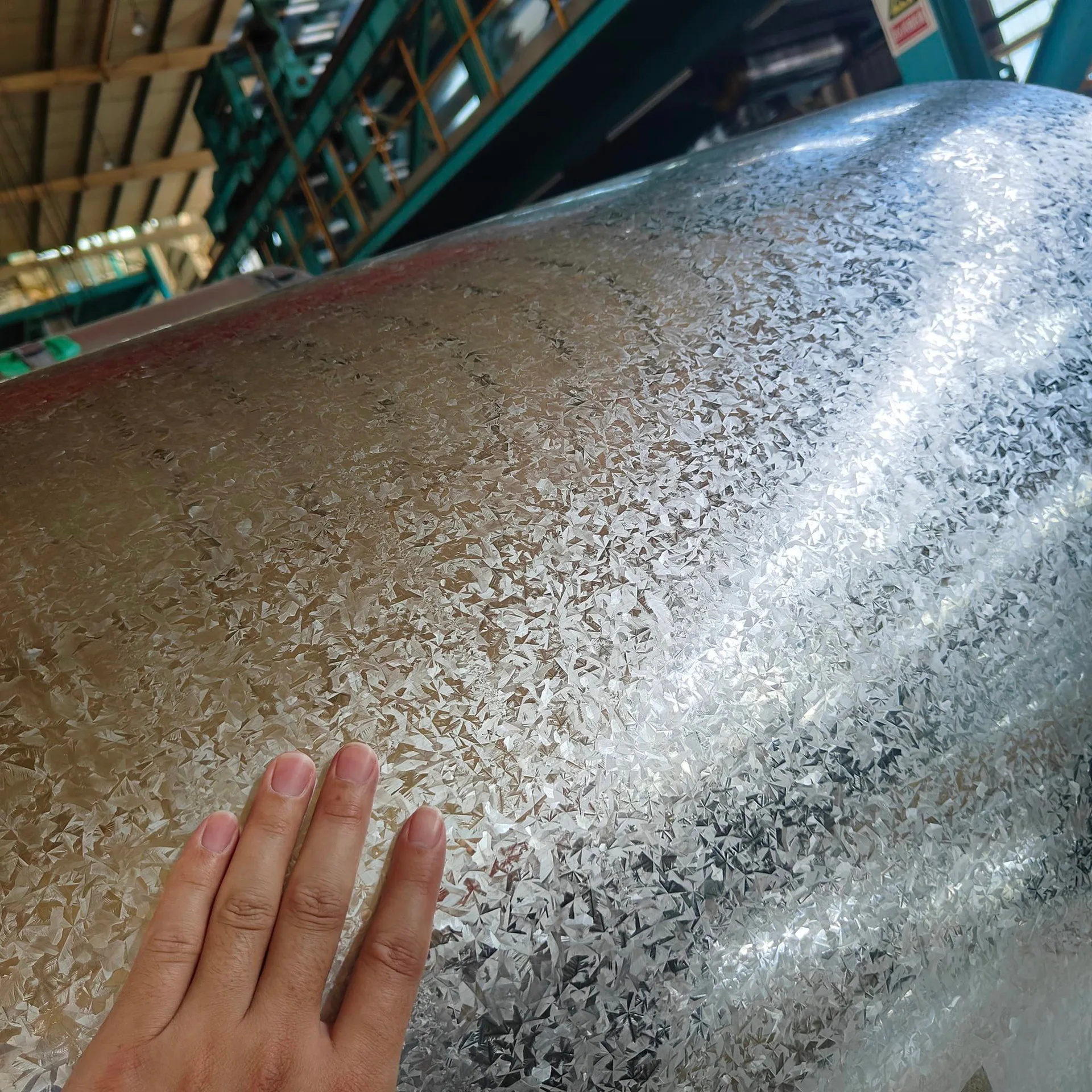
The surface of galvanized steel coil affects appearance, painting performance, storage stability and downstream processing. Common surface conditions include regular spangle, minimized spangle, zero spangle and skin-passed finish.
Regular spangle
Regular spangle has visible zinc crystal patterns. It is widely used for general construction and industrial applications where appearance requirements are moderate.
Minimized spangle
Minimized spangle has a finer and more uniform surface. It is often preferred for applications requiring better visual consistency.
Zero spangle
Zero spangle has a smoother and more uniform appearance. It is commonly selected for pre-painted galvanized steel, home appliances and applications requiring higher surface quality.
Surface treatment
To reduce the risk of white rust during storage and transportation, galvanized steel coils may be supplied with passivation, oiling, chromate-free treatment or anti-fingerprint treatment. For export orders, surface treatment and packaging should be carefully specified, especially for sea shipment.
7. What Are the Main Applications of Galvanized Steel Coil?
Galvanized steel coil is used across many industries because it offers a practical balance of corrosion resistance, strength, formability and cost efficiency.
Construction roofing and wall systems
Galvanized steel coil is widely roll formed into roofing sheets, wall cladding, corrugated sheets, floor decking, purlins and building envelope components. For outdoor building applications, zinc coating weight, thickness tolerance, yield strength and surface quality are key purchasing factors.
Pre-painted galvanized steel substrate
Many PPGI coils are produced from galvanized steel coil substrate. The quality of the galvanized base material strongly affects paint adhesion, corrosion resistance and service life of the final color-coated product.
HVAC and ventilation ducts
GI coil is commonly used to manufacture air ducts, ventilation systems and HVAC components. These applications require good bending, forming and seaming performance.
Home appliances
Refrigerators, washing machines, air conditioners and other appliances may use galvanized steel for shells, panels or internal structural parts. Surface flatness, dimensional accuracy and paintability are often important.
Automotive and transportation equipment
Some automotive parts, commercial vehicle components and transportation equipment use galvanized steel to improve corrosion resistance. These applications usually require strict mechanical properties and consistent material quality.
Light industry and metal fabrication
Shelves, cabinets, cable trays, doors, fences, steel furniture and stamped parts are frequently made from galvanized steel coil. The correct grade depends on whether the product will be bent, stamped, roll formed or structurally loaded.
8. How Can You Judge the Quality of Galvanized Steel Coil?
Professional buyers should evaluate galvanized steel coil through specifications, testing documents, surface inspection and supplier consistency, not only by price.
Zinc coating consistency
The zinc coating should meet the agreed standard and contract requirement. Uneven coating or insufficient zinc thickness may reduce corrosion resistance and cause quality claims.
Flatness and coil shape
Poor flatness can cause problems during slitting, cutting, roll forming, stamping or automated production. Edge waves, center buckles and poor coil winding should be avoided.
Surface defects
Common surface defects include zinc lumps, scratches, black spots, white rust, missed coating, roll marks, stains and color difference. The acceptable level depends on the final application.
Mechanical properties
Yield strength, tensile strength and elongation should match the intended use. A coil used for simple roofing profiles may not require the same properties as a coil used for deep drawing or structural applications.
Export packaging
For international shipping, packaging is critical. Moisture, condensation, handling damage and long sea transport can affect coil condition. Good export packaging usually includes waterproof paper, plastic film, steel sheet protection, edge protectors, strong strapping and proper pallet or eye-to-wall support.
9. What Should Buyers Confirm Before Ordering Galvanized Steel Coil?
To avoid misunderstanding and quality disputes, buyers should confirm all key technical and commercial details before purchasing.
| Item | What to Confirm |
|---|---|
| Standard | ASTM A653, EN 10346, JIS G3302, GB/T 2518 or other required standard. |
| Steel grade | DX51D, SGCC, S350GD, CS Type B or equivalent grade according to application. |
| Thickness and width | Nominal size, tolerance and downstream processing requirements. |
| Zinc coating | Z80, Z120, Z180, Z275, G60, G90 or other coating designation. |
| Surface finish | Regular spangle, minimized spangle, zero spangle or skin-passed surface. |
| Surface treatment | Passivated, oiled, dry, chromate-free or anti-fingerprint. |
| Coil weight and ID | Common inner diameters include 508 mm and 610 mm. |
| Edge condition | Mill edge or slit edge. |
| Application | Roofing, wall panel, ducting, stamping, slitting, PPGI substrate or structural use. |
| Packaging | Domestic packing, standard export packing or reinforced sea-worthy packing. |
A reliable galvanized steel coil supplier should not only quote a price, but also help buyers match the material specification with the final application. This is especially important for importers, distributors and project buyers who need stable quality across multiple shipments.
10. How Long Does Galvanized Steel Coil Last?
The service life of galvanized steel coil depends on zinc coating weight, atmospheric conditions, exposure level, maintenance, processing damage and whether additional paint or coating systems are used.
In dry indoor environments, galvanized steel may last for many years even with moderate coating weight. In humid, industrial or coastal environments, corrosion risk increases significantly. Cut edges, scratches and areas where water remains trapped can corrode faster than well-drained surfaces.
For long-term outdoor use, buyers should consider not only the zinc coating, but also design details such as drainage, ventilation, fasteners, coating compatibility and local environmental conditions.
11. Galvanized Steel Coil vs Galvalume Steel Coil: Which One Should You Choose?
Galvalume steel coil, also known as aluminum-zinc coated steel coil or GL coil, uses a coating mainly composed of aluminum, zinc and silicon. Compared with traditional galvanized steel, galvalume can offer excellent corrosion resistance in certain atmospheric environments and better heat reflectivity.
However, galvanized steel coil still has strong advantages:
- Good cut-edge protection due to zinc sacrificial behavior
- Wide application range
- Strong availability in global markets
- Competitive cost
- Good suitability for many forming and fabrication processes
The better choice depends on the application environment, project budget, forming method and expected lifespan. For many general construction and industrial applications, galvanized steel coil remains a practical and widely accepted option.
12. Frequently Asked Questions About Galvanized Steel Coil
Does galvanized steel coil rust?
Yes, galvanized steel coil can eventually rust, especially after the zinc coating is consumed or damaged. However, it provides much better corrosion resistance than uncoated carbon steel.
Is Z275 galvanized steel coil always better than Z120?
Not always. Z275 offers a heavier zinc coating and generally better corrosion protection, but it also costs more and may not be necessary for low-corrosion indoor applications. The right coating depends on the environment and use.
Can galvanized steel coil be painted?
Yes. Galvanized steel coil can be painted, and it is often used as the substrate for pre-painted galvanized steel coil. Proper surface treatment is necessary to ensure paint adhesion and long-term performance.
What causes white rust on galvanized steel coil?
White rust is commonly caused by moisture trapped between coil layers, condensation, poor ventilation or improper storage. Passivation, oiling, good packaging and dry storage can help reduce this risk.
What information should I provide when requesting a quotation?
You should provide standard, grade, thickness, width, zinc coating, surface finish, surface treatment, coil weight, inner diameter, edge condition, application, quantity and packaging requirements.
Conclusion: How Do You Choose the Right Galvanized Steel Coil?
Choosing the right galvanized steel coil is not only about finding the lowest price. A suitable GI coil should match the project environment, processing method, target standard, corrosion resistance requirement and final product application.
Before placing an order, buyers should clearly define the required standard, steel grade, zinc coating weight, thickness, width, surface condition and packaging method. For construction, roofing, wall cladding, HVAC, home appliances and metal fabrication, these factors directly influence product performance and long-term value.
In global steel trade, galvanized steel coil remains a highly practical and cost-effective material. By understanding its production process, zinc coating system, standards and quality evaluation methods, buyers can make more confident purchasing decisions and reduce the risk of material failure, processing issues or unnecessary cost.
Need Galvanized Steel Coil for Your Project?
If you are sourcing galvanized steel coil for roofing, wall panels, HVAC ducts, manufacturing, distribution or export projects, confirm your required standard, zinc coating, steel grade and application before ordering. A professional supplier can help you select the most suitable specification for reliable performance and better long-term value.