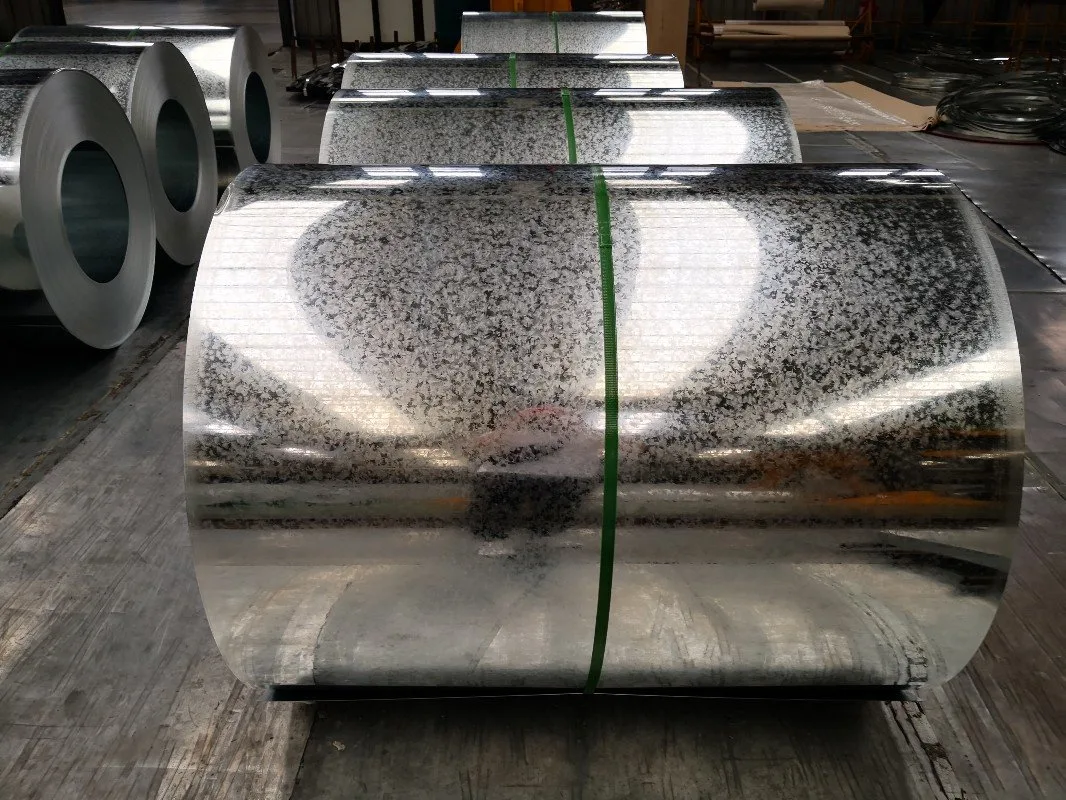
What Is Galvanized Steel Coil and How Do Zinc Coating, Passivation, Chromating, Anti-Fingerprint, and Oil Weight Affect Quality?
Technical guide to galvanized steel coil (GI): G90/Z275 coating mass, passivation, chromating, anti-fingerprint, oil weight, and quality defects on strip and sheet.
Galvanized steel coil (GI) remains the workhorse substrate for construction, HVAC, appliance, and light fabrication supply chains. When buyers search for zinc-coated coil under ASTM A653/A653M, EN 10346 (DX51D+Z, S280GD+Z, S350GD+Z), or JIS G3302 (SGCC/SGC), the real decision is rarely “zinc or no zinc.” It is whether coating mass, surface treatment, oil film, spangle, and mechanical grade are matched to forming severity and exposure class.
This article explains how continuous hot-dip galvanized coil is made, what G/Z coating designations actually mean, how passivation, chromating, anti-fingerprint films, and oil coating weight change logistics and fabrication outcomes, and which quality defects appear most often on GI strip, flat sheet, and downstream panels—together with their typical root causes.

What Is Galvanized Steel Coil and How Does Zinc Protect the Steel?
Continuous galvanized sheet is produced by cleaning and annealing cold-rolled strip, then immersing it in a molten zinc bath. Air knives meter the liquid zinc to the ordered coating mass before solidification. Unlike batch galvanizing after fabrication, continuous GI is designed to be formed after coating, so the coating structure is predominantly free zinc (eta phase) with a controlled thin alloy layer at the steel interface.
Zinc protects steel in two complementary ways:
- Barrier protection — a continuous metallic film isolates the substrate from moisture and oxygen.
- Cathodic (sacrificial) protection — at scratches, cut edges, and forming cracks, zinc corrodes preferentially and delays red rust on exposed steel.
Coating life in a given atmosphere is largely proportional to coating thickness (coating mass). That is why G90/Z275 typically outlasts G60/Z180 under the same outdoor conditions, provided packaging, design detailing, and maintenance are equal.
What Do G90, Z275, and Other GI Coating Designations Mean?
ASTM A653 uses G designations in inch-pound units and Z designations in SI units for total coating mass on both sides (triple-spot test basis under A924/A924M). Conversion is approximately:
1.00 oz/ft² ≈ 305 g/m². Therefore G90 ≈ Z275, G60 ≈ Z180, and G40 ≈ Z120.
| Designation | Min. triple-spot (both sides) | Approx. thickness if evenly split | Typical use |
|---|---|---|---|
| G30 / Z90 | 0.30 oz/ft² / ~90 g/m² | ~7–8 µm/side class | Indoor, short-life, or heavily painted systems |
| G40 / Z120 | 0.40 oz/ft² / ~120 g/m² | ~8–10 µm/side class | Light outdoor / general forming |
| G60 / Z180 | 0.60 oz/ft² / ~180 g/m² | ~13 µm/side class | Common construction baseline |
| G90 / Z275 | 0.90 oz/ft² / ~275 g/m² | ~19–21 µm/side class | Exterior panels, roofing substrate, structural sheet |
| G115+ / Z350+ | 1.15 oz/ft² / ~350 g/m²+ | heavier zinc | Aggressive climates or longer design life |
A G90 coating adds roughly 1.6 mils (~40–42 µm) total to sheet thickness when distributed on both sides. Because coating is not perfectly equal side-to-side or edge-to-center, purchase orders should cite the standard designation and request coating-mass verification rather than relying only on a local thickness gauge reading.
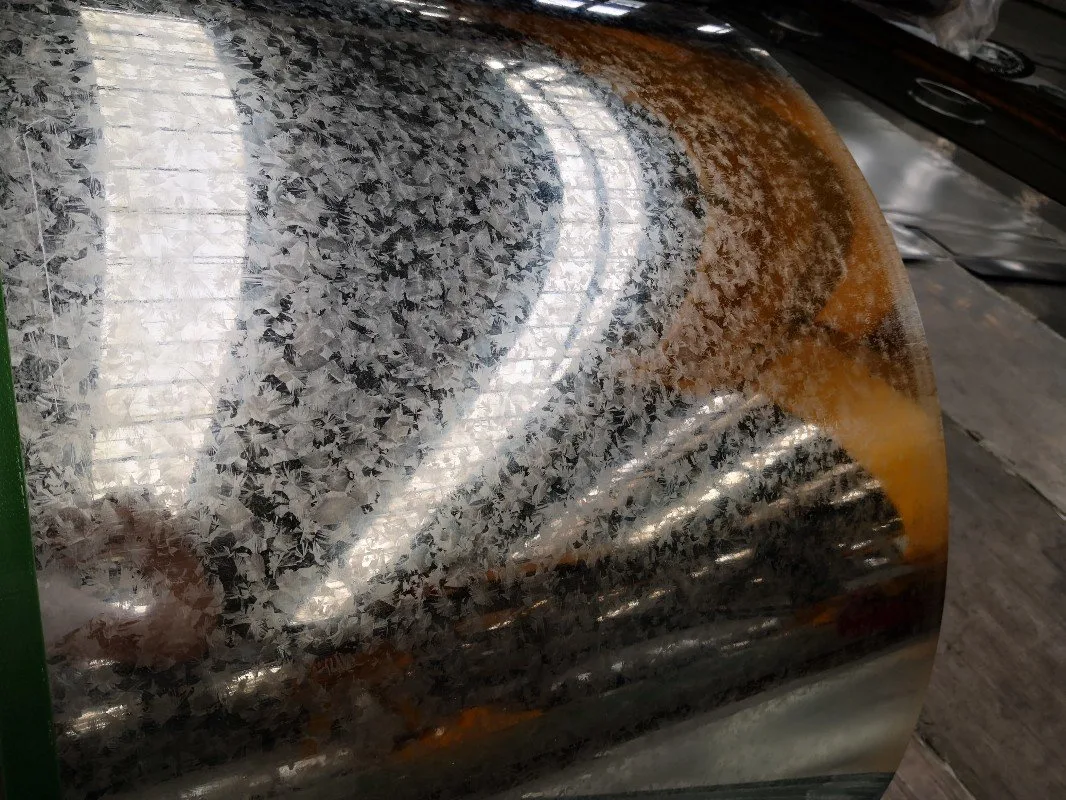
How Is GI Coil Converted into Strip, Sheet, and Building Products?
Slit strip
Mother coils are slit for purlins, studs, ducts, cable trays, tubing, and roll-forming feed. Edge burr, camber, and width tolerance control scrap rate and tool life. Heavy burrs cut packaging paper, remove oil, and create early edge corrosion nuclei.
Cut-to-length sheet / plate blanks
CTL lines produce flat sheets for cladding, enclosures, agricultural equipment, and further stamping. Shape defects—coil set, crossbow, center buckle—drive oil-canning visibility on wide panels even when coating mass is correct.
Roofing and panel substrates
GI is widely used as bare panel material in mild climates and as the metallic substrate under PPGI. For exterior bare use, G60–G90 (or Z180–Z275) is common; coastal projects often need heavier zinc, better packaging, and careful fastener selection. Where long-term bare atmospheric durability is critical, many designers compare GI against Galvalume (AZ) substrates rather than only raising zinc mass.
Why Do Passivation, Chromating, Anti-Fingerprint, and Oil Weight Matter on GI?
Fresh zinc is chemically active. Without surface treatment and moisture control, coils can develop wet-storage stain (white rust) within days during sea freight or humid yard storage.
Passivation and chromating
Chemical passivation creates a thin conversion film that slows white-rust formation under wet nested conditions. Traditional chromate systems are still ordered in some markets, while many export buyers now require Cr-free passivation. Orders should state chemistry class explicitly: chromated, trivalent, or chromium-free; chemically treated dry; or chemically treated and oiled.
Anti-fingerprint (AFP)
Clear organic or hybrid AFP films reduce fingerprints, improve handling cleanliness, and can support dry forming on selected lines. Film continuity and cure quality matter more than marketing labels. Incomplete AFP leaves mottled stain resistance; over-thick or under-cured film may powder on rolls or hurt weldability/conductivity.
Oil coating weight
Mill oil (vanishing oil or rust-preventive oil) lowers forming friction and adds short-term humidity protection. Industrial GI is often shipped with light oil on the order of roughly 0.5–2.5 g/m² per side, but the exact target must be agreed with the mill and validated by retained-oil measurement. Too little oil increases galling and scratch white-rust tracks; too much oil causes dirt pickup, coil telescoping risk in transit, and cleaning problems before painting.
Important: oil is not a substitute for passivation. For long ocean voyages, the package is usually passivation + appropriate oil (or AFP) + seaworthy wrapping + dry storage discipline.
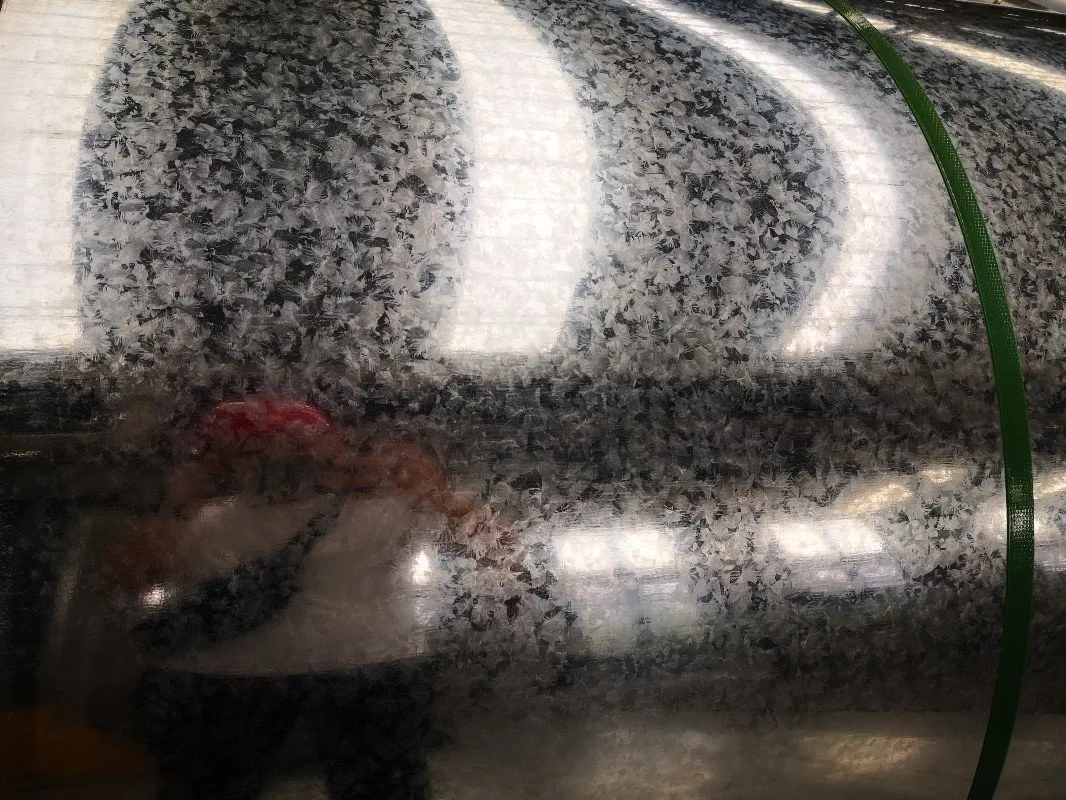
Which Quality Problems Occur on GI—and What Causes Them?
| Defect | Observation | Frequent causes |
|---|---|---|
| White rust / wet storage stain | White powdery or gray patches between wraps | Condensation in coils, damaged waterproof packing, weak/missing passivation, long humid storage, insufficient ventilation after rain exposure |
| Bare spots / thin zinc | Early red rust islands | Air-knife instability, dross, strip shape, under-ordered coating mass, abrasive handling after coating |
| Spangle non-uniformity | Uneven sparkle or dull bands | Bath chemistry, cooling rate, skin-pass differences; often cosmetic unless coating mass fails |
| Coating cracking at tight bends | Zinc cracks on outside radius | Heavy coating + high-strength substrate, too-small bend radius, inadequate lubrication, reverse bending |
| Black marks / friction burnish | Dark linear tracks after roll forming | Dry forming without enough oil/AFP, dirty rolls, high entry tension, sheet-on-sheet sliding |
| Oil streaks and dirty surface | Stripes, sticky dust adhesion | Uneven oiling, excessive oil weight, warm storage after oiling |
| Edge wave / camber after slitting | Poor nesting, tracking issues | Incoming shape, incorrect slit tension, dull knives, residual stress release |
| Paint adhesion failure later | Blistering or peel on powder/coil coat | Residual oil, incompatible passivation, incomplete cleaning/pretreatment before organic coating |
How Should Buyers Specify Galvanized Steel Coil?
- Standard and grade: ASTM A653 CS/FS/SS Grade xx, or EN 10346 DX51D+Z / S350GD+Z, etc.
- Thickness, width, coil ID/OD, and whether thickness is total product thickness.
- Coating designation: G60/G90 or Z180/Z275 (and any single-side requirements if used).
- Surface: regular/minimized spangle; skin-passed or not; exposed/unexposed quality.
- Treatment package: chromated or Cr-free passivated; AFP if required; oiled/dry and target oil range.
- Mechanical targets for forming: yield, tensile, elongation or hardness band.
- Tests: coating mass (triple-spot), tensile, bend, and MTC linkage to coil numbers.
- Packaging for destination climate and voyage duration.
For mild indoor fabrication, lighter zinc with controlled oil may be enough. For exterior construction substrates, G90/Z275 with verified passivation and export packing is a common default. For severe forming, discuss coating adhesion and whether a lighter coating mass or forming grade reduces cracking risk.
Key Takeaways
GI performance is a system: zinc mass sets corrosion reserve; passivation/chromating and AFP protect logistics appearance; oil weight balances formability against cleanliness; and mechanical grade plus edge/shape quality decide whether strip, sheet, and panels can be produced without scrap. Most “mystery” claims are traceable to moisture management, under-specified surface treatment, abrasion, or mismatched bend severity—not to zinc metallurgy alone.
For galvanized steel coil, slit strip, or sheet requirements, contact SUNSEA STEEL CO., LIMITED at [email protected] or WhatsApp +86 152 6555 2259 via https://wa.me/8615265552259.
Frequently Asked Questions
What is galvanized steel coil (GI)?
Galvanized steel coil is cold-rolled steel continuously hot-dip coated with zinc. It is commonly ordered to ASTM A653/A653M, EN 10346, or JIS G3302 and used for strip, sheet, ducting, framing, and as the substrate for PPGI.
What is the difference between G90 and Z275?
They are essentially equivalent coating-mass designations in different unit systems. G90 means a minimum triple-spot average of 0.90 oz/ft2 total both sides; Z275 is about 275 g/m2 total both sides. Conversion uses approximately 1 oz/ft2 = 305 g/m2.
Why does galvanized coil get white rust during shipping?
White rust is wet-storage stain caused by moisture trapped between wraps with limited oxygen. Weak passivation, damaged packing, condensation during sea freight, and long humid storage are the main drivers.
Do I need chromating or Cr-free passivation on GI coil?
Chemical passivation significantly reduces wet-storage stain risk. Many markets still accept chromate treatments, but export and environmentally restricted projects increasingly specify chromium-free passivation. State the chemistry explicitly on the order.
How much oil is typically applied to galvanized steel coil?
Light oil films are often in the approximate range of 0.5-2.5 g/m2 per side, depending on mill practice and customer forming needs. Excess oil harms paintability and cleanliness; insufficient oil increases scratches and early stain.
Can GI coil be used for outdoor roofing without paint?
Yes in suitable climates when coating mass, detailing, and maintenance are adequate. G60-G90 (Z180-Z275) are common construction ranges. For aggressive coastal or long-life bare exposure, heavier zinc or alternative substrates such as Galvalume should be evaluated.
What causes zinc cracking on tight bends?
Heavy coating on high-strength steel, too-small inside bend radii, poor lubrication, and reverse bending are typical causes. Match grade, coating mass, and tooling radius before full production.