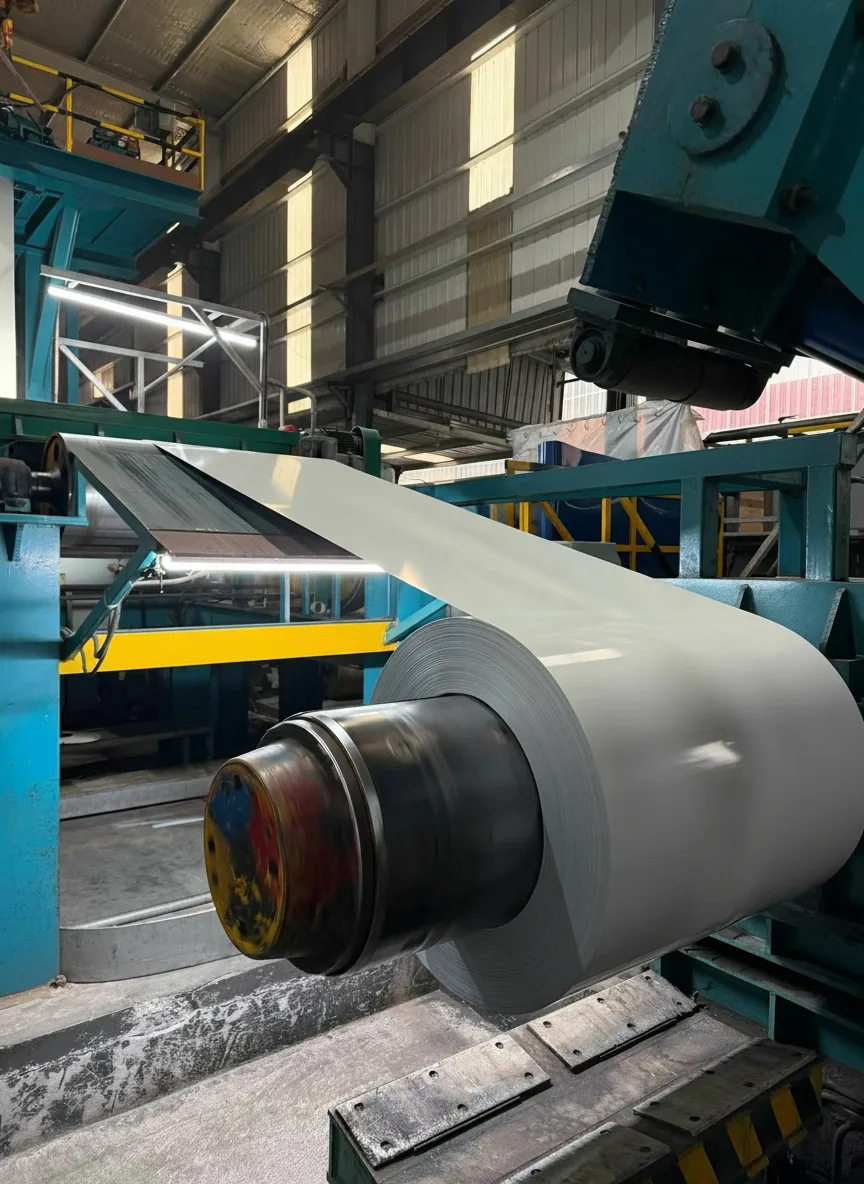
PPGI vs PPGL Steel Coil: Which Pre-Painted Steel Coil Is Better for Your Project?
Compare PPGI and PPGL steel coil in substrate, coating structure, corrosion resistance, color durability, heat reflectivity, applications, cost and buying tips.
A complete comparison of PPGI steel coil and PPGL steel coil, including substrate structure, metallic coating, paint system, corrosion resistance, weatherability, heat performance, applications, cost and buying advice.
PPGI, pre-painted galvanized steel coil, and PPGL, pre-painted Galvalume steel coil, are two important color-coated steel coil products. Both are made by applying a paint system over metallic-coated steel, but they are built on different substrates and therefore perform differently in roofing, wall cladding, appliances and industrial manufacturing.
In simple terms, PPGI uses galvanized steel as the base metal, while PPGL uses Galvalume steel as the base metal. The top paint may look similar, and both products can be supplied in RAL colors, matte finish, embossed texture or customized patterns. However, the hidden substrate under the paint has a major influence on corrosion resistance, cut-edge behavior, heat reflectivity, weather durability and long-term value.
This 100% original guide explains the differences between PPGI and PPGL steel coil, helping importers, distributors, roofing sheet manufacturers, contractors and purchasing managers choose the right pre-painted steel coil for each project.
1. PPGI vs PPGL Steel Coil: What Is the Quick Answer?
If you need a cost-effective, widely available color-coated steel coil with strong zinc-based protection and good general fabrication performance, PPGI steel coil is often the practical choice. If you need a color-coated coil for long-life roofing, wall cladding, hot climates and better atmospheric corrosion resistance on broad exposed surfaces, PPGL steel coil is often the stronger option.
The final choice should not be based only on price or color. PPGI and PPGL can both be produced in similar colors, thicknesses and paint systems. The real difference is the metallic-coated substrate below the paint. PPGI is based on galvanized steel, while PPGL is based on Galvalume steel. This changes how the product behaves after years of sun, rain, heat, scratches, cutting and installation.
| Decision Factor | PPGI Steel Coil | PPGL Steel Coil |
|---|---|---|
| Base substrate | Galvanized steel coil | Galvalume steel coil |
| Metallic coating | Zinc coating | Aluminum-zinc-silicon alloy coating |
| Best advantage | Economical, versatile, good cut-edge zinc protection | Better broad-surface weather resistance and heat reflectivity |
| Common use | General roofing, wall panels, appliances, doors and panels | Durable roofing, cladding and architectural exterior panels |
| Typical buyer focus | Cost, availability and easy processing | Long-term outdoor durability and roof performance |
2. What Are PPGI and PPGL Steel Coils?
PPGI steel coil means pre-painted galvanized steel coil. It is made by applying primer, top paint and back coating to galvanized steel coil. The galvanized substrate provides zinc-based protection, while the paint system provides color, gloss, UV resistance and additional weather protection.
PPGL steel coil means pre-painted Galvalume steel coil. It is made by applying a paint system to Galvalume steel, which has an aluminum-zinc alloy metallic coating. The paint provides color and weather protection, while the Galvalume substrate provides strong atmospheric corrosion resistance and heat reflection.
Both PPGI and PPGL are color-coated steel coil products. They can be slit, cut, corrugated, roll formed and processed into roofing sheets, wall cladding, sandwich panel surfaces, ceiling panels, doors, appliances and decorative metal products.
3. How Is the Coating Structure Different Between PPGI and PPGL?
Both products have a layered structure. From inside to outside, they include a steel substrate, metallic coating, pretreatment layer, primer, top paint and back coating. The key difference is the metallic coating under the paint.
| Layer | PPGI Steel Coil | PPGL Steel Coil |
|---|---|---|
| Steel substrate | Cold rolled or hot rolled base steel, depending on grade | Cold rolled or hot rolled base steel, depending on grade |
| Metallic coating | Zinc coating, often identified by Z coating weight | Aluminum-zinc-silicon coating, often identified by AZ coating weight |
| Pretreatment | Improves coating adhesion and corrosion resistance | Improves coating adhesion and corrosion resistance |
| Primer | Bonding layer between substrate and top paint | Bonding layer between substrate and top paint |
| Top paint | PE, SMP, HDP, PVDF or other coating system | PE, SMP, HDP, PVDF or other coating system |
| Back coating | Protects the underside during use and storage | Protects the underside during use and storage |
Because the visible paint layer may look the same, buyers sometimes overlook the substrate. This can lead to wrong product selection. A red PPGI coil and a red PPGL coil may look similar in the warehouse, but their long-term behavior on a roof can be very different.
4. Which Has Better Corrosion Resistance: PPGI or PPGL Steel Coil?
For broad, exposed roof and wall surfaces in many atmospheric environments, PPGL steel coil usually offers better long-term corrosion resistance than PPGI of comparable quality. The aluminum-rich Galvalume coating forms a strong barrier that slows down corrosion on open surfaces, while the paint system adds another protective layer.
PPGI steel coil still provides reliable corrosion resistance and is widely used around the world. The zinc coating under the paint protects the steel substrate, and the paint system improves durability and appearance. In many general construction and manufacturing applications, PPGI offers an excellent balance between cost and performance.
Corrosion performance depends on these factors
- Metallic coating weight, such as Z coating for PPGI and AZ coating for PPGL;
- Paint type, primer quality, top paint thickness and back paint thickness;
- Outdoor environment, including humidity, salt, industrial pollution and UV exposure;
- Product design, drainage, overlap, fasteners and cut-edge exposure;
- Storage, transportation, installation quality and maintenance.
For long-life roofing sheets and exterior wall cladding, PPGL is often recommended. For general indoor, semi-outdoor, appliance or economical building applications, PPGI can be the more practical choice.
5. Which Keeps Color Better Outdoors?
Color retention depends mainly on the paint system, not only on whether the substrate is PPGI or PPGL. A high-quality PVDF or HDP coating can keep color better than a standard PE coating. However, the substrate also affects long-term performance because corrosion under the paint can cause blistering, peeling or staining.
PPGL is often chosen for exposed roofing and cladding because its Galvalume substrate supports strong long-term outdoor durability. When combined with a high-performance paint system such as SMP, HDP or PVDF, PPGL can deliver excellent color appearance in demanding environments.
| Paint System | General Features | Suitable Use |
|---|---|---|
| PE polyester | Economical, wide color range and good general performance | Standard roofing, wall panels and cost-sensitive projects |
| SMP silicon modified polyester | Better weatherability and color retention than PE | Outdoor roofs with improved durability requirements |
| HDP high durability polyester | Strong UV resistance and good long-term color stability | Industrial and commercial exterior applications |
| PVDF | Excellent weatherability, chemical resistance and color retention | Premium architectural roofing and high-value cladding |
6. Which Protects Cut Edges Better?
Cut-edge behavior is one area where PPGI can have an advantage. Because galvanized steel uses zinc coating, it provides strong sacrificial protection around scratches and cut edges. Zinc can help protect nearby exposed steel by corroding preferentially.
PPGL contains aluminum-zinc alloy coating. The aluminum-rich part provides excellent barrier protection on broad surfaces, but it does not offer the same level of zinc sacrificial action at cut edges. This does not mean PPGL is weak; it means that processing and installation should control exposed edges, scratches and fastener areas carefully.
Practical edge protection advice
Choose PPGI when products require many holes, trimming operations or exposed cut edges. Choose PPGL when the product is mainly a roof or wall panel with good design, proper overlaps, controlled cutting and long-term exposure on broad surfaces.
7. Which Is Better for Heat, Sunlight and Roof Temperature?
PPGL generally has an advantage in heat reflectivity because the Galvalume substrate contains a high percentage of aluminum. For roofing projects in hot climates, this can be valuable. Better reflectivity can help reduce heat absorption, especially when combined with light-colored paint.
PPGI can also perform well under sunlight if the paint system is properly selected. The final roof temperature depends heavily on color, gloss, coating type, insulation, ventilation and building design. A white or light gray PPGI sheet may reflect more sunlight than a dark PPGL sheet, so color should always be considered together with substrate.
| Heat Factor | PPGI Steel Coil | PPGL Steel Coil |
|---|---|---|
| Substrate reflectivity | Moderate under the paint system | Generally stronger because of aluminum-rich coating |
| Paint color influence | Very important | Very important |
| Hot climate roofing | Good with proper paint and design | Often preferred for durable exterior roofing |
8. Where Should PPGI and PPGL Steel Coil Be Used?
The right product depends on where and how the coil will be used. PPGI is extremely versatile and often preferred for general manufacturing. PPGL is particularly strong for roofs and exterior envelopes that need longer outdoor durability.
| Application | Recommended Product | Reason |
|---|---|---|
| Economical roofing sheets | PPGI | Good cost-performance balance and broad market availability |
| Long-life roofing sheets | PPGL | Better atmospheric corrosion resistance and heat reflectivity |
| Wall cladding | PPGI or PPGL | Selection depends on climate, design life, paint system and budget |
| Appliance panels | PPGI | Good forming behavior, paint appearance and economical supply |
| Sandwich panel faces | PPGI or PPGL | Choose based on indoor/outdoor exposure and insulation system |
| Decorative panels | PPGI or PPGL | Color, texture and surface quality are key factors |
| Hot climate metal roofs | PPGL | Aluminum-zinc substrate supports better heat reflection |
| Products with many cut edges | PPGI | Zinc coating gives stronger sacrificial edge protection |
9. Which Paint Systems Are Available for PPGI and PPGL Coils?
Both PPGI and PPGL can use similar paint systems. The most common options include PE, SMP, HDP and PVDF. The best paint system depends on expected service life, climate, UV intensity, building type and budget.
Standard PE coating
Economical and suitable for general applications. It is widely used in standard roofing, wall panels and indoor products where extreme weatherability is not required.
SMP coating
Provides improved outdoor durability and color retention. It is useful for roofing and cladding projects that need better performance than standard PE.
HDP coating
Offers high durability and good UV resistance for industrial roofs, commercial buildings and regions with strong sunlight.
PVDF coating
Recommended for premium architectural projects because of excellent weatherability, color stability and chemical resistance.
When comparing quotations, buyers should ask for top paint thickness, primer thickness, back coat thickness, gloss range, color tolerance, T-bend performance, pencil hardness and salt spray or weathering test references where applicable.
10. Which Is More Cost-Effective: PPGI or PPGL?
PPGI is often more economical in initial purchase price because galvanized steel is widely available and commonly used as a substrate for color-coated products. For projects where cost control is the main priority and the environment is not too severe, PPGI can be a very efficient material choice.
PPGL may have a higher initial price because Galvalume substrate and specific coating requirements can cost more. However, in roofing and outdoor cladding projects, PPGL can be more cost-effective over the full service life if it reduces corrosion risk, improves weather resistance and extends roof performance.
Cost should be evaluated by total value
- Initial coil price per ton;
- Metallic coating weight and paint system quality;
- Expected roof or panel service life;
- Maintenance, leakage and replacement risk;
- Climate and exposure severity;
- Customer positioning in the local market.
For short-term or economical projects, PPGI may be enough. For long-term outdoor roofing and premium building envelopes, PPGL often provides stronger value.
11. What Specifications Should Buyers Confirm Before Ordering?
Before ordering PPGI or PPGL steel coil, buyers should make sure that all technical details are clear. Comparing two offers without checking substrate, coating weight and paint system can be misleading.
| Specification Item | PPGI Steel Coil | PPGL Steel Coil |
|---|---|---|
| Base material | Pre-painted galvanized steel | Pre-painted Galvalume steel |
| Metallic coating | Z coating, such as Z60, Z100, Z180 or Z275 | AZ coating, such as AZ50, AZ100, AZ150 or AZ185 |
| Thickness | Commonly customized from thin gauge to thicker construction grades | Commonly customized from thin gauge to thicker construction grades |
| Width | Full width or slit width according to production line | Full width or slit width according to production line |
| Top paint | PE, SMP, HDP, PVDF or customized system | PE, SMP, HDP, PVDF or customized system |
| Color | RAL color, sample color, matte, embossed or printed finish | RAL color, sample color, matte, embossed or printed finish |
| Back paint | Service back coat or special back paint | Service back coat or special back paint |
| Mechanical properties | Yield strength, tensile strength and elongation | Yield strength, tensile strength and elongation |
| Packing | Seaworthy export packing, eye-to-wall or eye-to-sky | Seaworthy export packing, eye-to-wall or eye-to-sky |
For roofing sheet production, buyers should also confirm forming profile, bending requirements, protective film, coil weight, inner diameter and whether the surface must be anti-fingerprint or easy-clean.
12. How Should You Choose Between PPGI and PPGL Steel Coil?
The best way to choose is to start with the final application. A coil used for indoor appliance panels does not need the same substrate performance as a coil used for a factory roof exposed to sun, rain and temperature changes for many years.
Choose PPGI when:
- You need an economical color-coated steel coil for general use;
- The product requires many cut edges, holes or forming operations;
- The application is appliances, doors, ceiling panels, indoor panels or economical roofing;
- Your customers prioritize price, availability and common market specifications;
- Zinc coating performance is suitable for the expected environment.
Choose PPGL when:
- You need stronger long-term outdoor durability for roofing or cladding;
- The project is in a hot climate where heat reflection is important;
- The roof or wall surface will be broadly exposed to weather;
- Your customer wants higher-performance color-coated steel products;
- The design controls cut edges, overlaps and installation quality properly.
Many professional distributors supply both PPGI and PPGL because different customers need different balances of cost, performance and durability. A reliable supplier should help buyers match the substrate, paint system and specifications to the real project conditions.
13. Frequently Asked Questions About PPGI vs PPGL Steel Coil
What does PPGI steel coil mean?
PPGI means pre-painted galvanized steel coil. It uses galvanized steel as the substrate and adds primer, top paint and back coating to provide color, weather resistance and surface protection.
Is PPGL better than PPGI?
PPGL is often better for long-life roofing and outdoor cladding because the Galvalume substrate provides strong broad-surface corrosion resistance and heat reflectivity. PPGI may be better for cost-sensitive projects, general fabrication and applications with many cut edges.
Can PPGI and PPGL use the same paint colors?
Yes. Both can be supplied in RAL colors, customized colors, matte finish, embossed finish or printed patterns. The visible color can be similar, but the substrate under the paint is different.
Which is better for metal roofing sheets?
PPGL is often preferred for durable metal roofing sheets, especially in hot climates and outdoor environments. PPGI is also widely used for roofing when the project requires economical performance and suitable zinc coating protection.
What should I compare before choosing PPGI or PPGL?
Compare substrate type, metallic coating weight, paint system, paint thickness, steel grade, thickness tolerance, color, forming requirements, application environment, expected service life and total cost.
Need PPGI or PPGL Steel Coil for Your Market?
Sunsea Steel supplies pre-painted galvanized steel coil, pre-painted Galvalume steel coil, galvanized steel coil, Galvalume steel coil and related roofing sheet materials for international buyers, distributors and manufacturers.
If you need help comparing PPGI and PPGL for roofing, cladding, appliances or industrial products, share your target thickness, color, coating weight, paint system, application and destination market with our team. We can help you choose a practical and competitive color-coated steel solution.
Contact Sunsea SteelFrequently Asked Questions
What does PPGI steel coil mean?
PPGI means pre-painted galvanized steel coil. It uses galvanized steel as the substrate and adds primer, top paint and back coating to provide color, weather resistance and surface protection.
Is PPGL better than PPGI?
PPGL is often better for long-life roofing and outdoor cladding because the Galvalume substrate provides strong broad-surface corrosion resistance and heat reflectivity. PPGI may be better for cost-sensitive projects, general fabrication and applications with many cut edges.
Can PPGI and PPGL use the same paint colors?
Yes. Both can be supplied in RAL colors, customized colors, matte finish, embossed finish or printed patterns. The visible color can be similar, but the substrate under the paint is different.
Which is better for metal roofing sheets?
PPGL is often preferred for durable metal roofing sheets, especially in hot climates and outdoor environments. PPGI is also widely used for roofing when the project requires economical performance and suitable zinc coating protection.
What should I compare before choosing PPGI or PPGL?
Compare substrate type, metallic coating weight, paint system, paint thickness, steel grade, thickness tolerance, color, forming requirements, application environment, expected service life and total cost.